The Body Remembers: How Martial Arts Training Is Helping American Trauma Survivors Reclaim Themselves
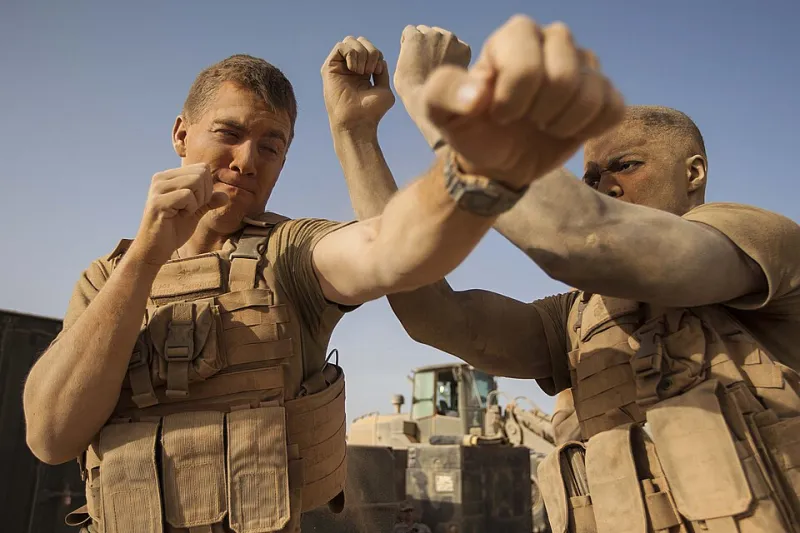
Photo: Sgt. Austin Hazard, Public domain, via Wikimedia Commons
Marcos Rivera spent three years in talk therapy after returning from his second deployment to Afghanistan. He was articulate about his experiences. He understood, intellectually, the mechanisms of post-traumatic stress. He could describe his triggers with clinical precision. And yet, he told his therapist, he still felt like a stranger in his own body—hypervigilant at the grocery store, unable to sleep through the night, perpetually braced for a threat that never materialized.
It was not until a fellow veteran introduced him to a traditional Japanese martial arts program in San Antonio that something began to shift. "The first time my instructor had us focus on just breathing—on the sensation of air moving through the body—something released," Rivera recalls. "It was the first time in years I felt like I actually lived inside myself."
His experience is not unique. Across the United States, trauma survivors—veterans, abuse survivors, first responders, and others who have lived through profound threat—are finding in martial arts training something that neuroscience is only beginning to fully explain.
What Trauma Does to the Body
To understand why embodied practice works, it is first necessary to understand what trauma does to the nervous system. Dr. Bessel van der Kolk, whose landmark research is detailed in The Body Keeps the Score, has demonstrated that traumatic experience fundamentally reorganizes the brain's threat-detection architecture. The amygdala—the brain's alarm system—becomes hypersensitized. The prefrontal cortex, responsible for rational assessment and emotional regulation, loses its ability to effectively override that alarm.
The result is a nervous system locked in a state of chronic preparedness: a body perpetually mobilized for danger that is no longer present. Conventional talk therapy, while valuable, primarily engages the cognitive and verbal processing centers of the brain. For many survivors, it cannot reach the subcortical structures where traumatic memory is actually stored—what clinicians sometimes describe as the "speechless terror" of post-traumatic stress.
This is precisely where body-based interventions enter the conversation.
The Samurai Body: Breath, Awareness, and Regulation
The martial arts tradition that descended from classical samurai training was never designed exclusively as a system of combat. At its philosophical core, it was a comprehensive discipline of self-mastery—and that mastery began with the body. The foundational practices of controlled breathing (kokyu), centered posture (kamae), and present-moment physical awareness were understood by generations of practitioners as prerequisites for any effective action, in battle or in life.
These same practices, when examined through a contemporary neuroscientific lens, map directly onto the mechanisms of nervous system regulation. Slow, diaphragmatic breathing—a cornerstone of traditional martial arts training—activates the parasympathetic nervous system, counteracting the chronic sympathetic arousal that characterizes post-traumatic stress. Deliberate, repetitive physical movement engages the cerebellum and basal ganglia in ways that support the re-establishment of a felt sense of bodily safety.
Dr. Peter Levine, developer of Somatic Experiencing therapy, has described this process as the completion of interrupted biological responses—the body's natural mechanism for processing and discharging threat responses that were never fully resolved at the time of the traumatic event.
From the Dojo Floor: American Survivors Speak
Tamika Johnson, a social worker in Chicago who survived domestic violence, enrolled in a women's self-defense program rooted in traditional Japanese martial arts principles two years ago. She was initially skeptical. "I'd done every kind of therapy," she says. "I knew my story. What I didn't know was how to feel safe again."
The transformation, she explains, was incremental and profoundly physical. Learning to hold a stable stance. Practicing controlled exhalation under simulated stress. Feeling the ground beneath her feet with deliberate awareness. "Every class, I was reclaiming a little more of my own body," she says. "Not as something that had been hurt, but as something that could be strong."
This trajectory—from hypervigilance toward what trauma researchers call window of tolerance expansion—is precisely what structured martial arts training appears to facilitate. The dojo provides what Dr. van der Kolk identifies as essential to trauma recovery: a safe context in which to experience physical activation, tolerate that activation without being overwhelmed by it, and return to a regulated state. Repeated over time, this cycle literally rewires the nervous system's threat-response threshold.
For James Whitfield, a former firefighter from Atlanta who developed PTSD following a structural collapse incident, the discipline of kata practice was transformative in a specific way. "The repetition was the point," he explains. "You're doing the same movements, breathing the same way, hundreds of times. Your body starts to believe that it can handle intensity without falling apart. That belief changes everything."
The Integration of Ancient Method and Modern Therapy
It is worth noting that the most effective programs combining martial arts with trauma recovery do not position the two approaches as alternatives. Rather, they function as complements. A growing number of licensed therapists and clinical programs—including initiatives affiliated with the U.S. Department of Veterans Affairs—are integrating body-based martial arts practices into broader treatment frameworks that also include cognitive processing therapy and other evidence-based modalities.
The martial arts component addresses what talk therapy cannot always reach: the subcortical, somatic dimension of traumatic memory. The therapeutic framework provides the interpretive and relational context within which physical change can be understood and integrated.
At HanzoEdu, the foundational understanding that samurai training was always concerned with the whole person—body, mind, and spirit in disciplined alignment—provides a natural philosophical home for this integrative approach. The ancient practitioners who developed these methods did not distinguish sharply between physical training and psychological cultivation. They understood them as a single, unified practice.
A Path Back to Agency
The most consistent theme across the accounts of trauma survivors who have found healing through martial arts is not strength in the conventional, physical sense. It is agency—the restored sense that one inhabits one's body as a subject rather than as a site of past injury.
That restoration does not happen quickly, and it does not happen without guidance from qualified instructors who understand both the discipline and its therapeutic dimensions. But for a growing number of Americans carrying the weight of unresolved trauma, the dojo is proving to be something no one fully anticipated: a place where the body finally comes home.