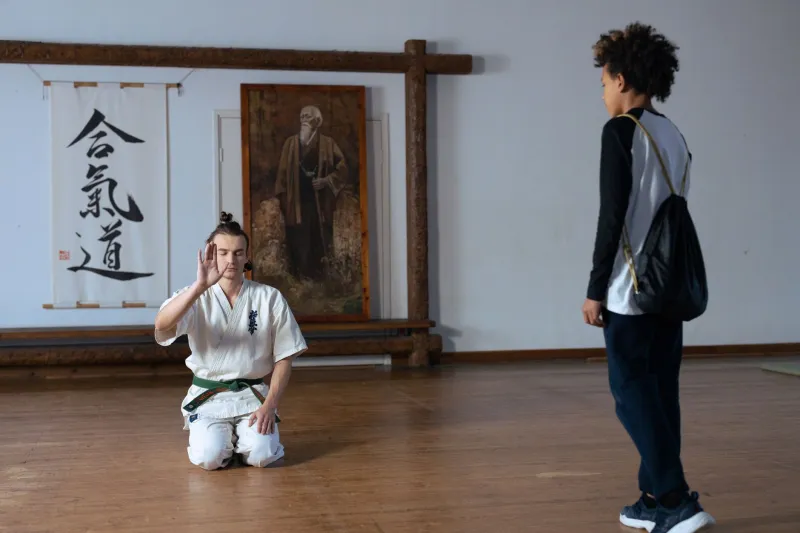
Winning the Inner War: How Samurai Self-Awareness Is Freeing Americans from the Grip of Social Media

Photo: Haripriya 12, CC BY-SA 4.0, via Wikimedia Commons
Long before smartphones existed, samurai warriors trained relentlessly to master a far more dangerous adversary than any opponent on the battlefield — their own minds. Today, practitioners and therapists across the United States are drawing on the ancient concept of mushin to help Americans recognize compulsive digital habits and reclaim sovereignty over their attention. The dojo, it turns out, may be one of the most effective treatment rooms in the modern age.
The Opponent You Cannot See
Social media addiction does not announce itself. It does not arrive with a warning label or a clear moment of defeat. It accumulates quietly — in the reflexive reach for a phone before morning coffee, in the hollow feeling after forty minutes of scrolling that produced nothing of value, in the creeping awareness that one's attention is no longer entirely one's own.
According to a 2023 Gallup survey, nearly one in five American adults reported feeling significantly distracted by their phones during time they had intended to spend on something else. For younger Americans between the ages of eighteen and thirty-four, that figure climbed above thirty percent. The scale of the problem is not in dispute. What remains elusive, for many, is a framework that feels genuinely empowering rather than merely restrictive.
This is precisely where samurai philosophy offers something that most digital wellness programs do not: a tradition of internal combat.
Mushin and the Uncluttered Mind
Mushin — often translated as "mind without mind" or "no mind" — is one of the foundational mental states sought by martial artists in the Japanese tradition. It describes a condition of total presence, in which the practitioner is neither paralyzed by past performance nor anxious about future outcomes. The mind flows. It responds without hesitation, without the interference of ego or distraction.
For the classical samurai, achieving mushin was the product of years of disciplined repetition — kata, meditation, breathwork, and the deliberate cultivation of self-awareness. The warrior had to know, with precision, what was happening inside before he could respond effectively to what was happening outside.
Dr. Renata Osei, a licensed psychologist based in Atlanta who incorporates mindfulness-based cognitive therapy into her practice, sees a direct parallel to the challenges her clients face with compulsive phone use. "What I observe repeatedly is that people are not choosing to scroll," she explains. "They are reacting. The phone buzzes, the app refreshes, and they respond before any conscious decision has been made. The samurai framework gives my clients a language for that gap — the space between stimulus and response — and a reason to care about widening it."
The concept of mushin does not demand the elimination of thought. It demands awareness of thought. That distinction is critical. Practitioners who study under HanzoEdu's curriculum learn early that the goal is not to become a person who never feels the pull of distraction, but to become a person who recognizes that pull the moment it arises — and chooses deliberately.
From the Training Floor to the Notification Screen
The transfer of martial discipline into digital discipline is not metaphorical. It is structural.
In traditional kenjutsu and iaijutsu training, students spend considerable time in what instructors call "observation practice" — studying their own reactions, their breathing patterns, their moments of tension and release, before a single technique is executed. The body must be read before it can be commanded.
Marcus Tillman, a martial arts instructor in Columbus, Ohio, who has taught for over two decades and now integrates samurai philosophy into his adult wellness programs, began noticing something several years ago. "Students who trained seriously started reporting changes in their relationship with their phones without me ever mentioning the subject," he recalls. "The heightened body awareness, the practice of catching the mind wandering during kata — it was transferring naturally. They were noticing the compulsive reach before it happened."
Tillman now addresses digital habits directly as part of his intermediate curriculum. He assigns what he calls a "notification audit" — a structured, two-week practice in which students document every time they reach for their phone, note what they were feeling immediately before reaching for it, and assess whether the action served a genuine purpose. The exercise is borrowed almost entirely from the samurai practice of hansei, or reflective self-examination.
"The phone is just the modern version of the undisciplined mind," he says. "The samurai faced the same enemy in different clothing."
The Role of Ritual in Reclaiming Attention
One of the most practical contributions that samurai philosophy makes to the conversation about digital wellness is its emphasis on ritual as a technology of the self.
The samurai day was organized around ceremony — the precise arrangement of equipment, the formalized greeting of fellow practitioners, the structured beginning and end of training. These rituals were not mere tradition for its own sake. They served a neurological function: they signaled to the mind that a transition was occurring, that a different quality of attention was now required.
For Americans struggling with compulsive phone use, therapists who work within this framework often recommend the creation of what they call "threshold rituals" — brief, intentional practices that mark the beginning and end of phone-free periods. These might include a single deliberate breath before placing the phone in a designated drawer, or a short written reflection at the end of an evening before the device is set aside for the night.
Dr. Osei notes that these practices work not because they are dramatic, but because they are consistent. "The samurai did not transform himself with one great act of will. He transformed himself through ten thousand small acts of deliberate attention. That is exactly what we are asking of our clients — not heroics, but discipline."
The Deeper Invitation
The samurai path has never been primarily about combat. It has always been about the relentless, honest examination of the self — the willingness to face one's own weaknesses without flinching and to commit to improvement regardless of how uncomfortable that process becomes.
Social media addiction, in this light, is not a character flaw. It is an invitation to practice. It is the modern equivalent of the opponent who reveals exactly where your guard is weak.
For those who choose to answer that invitation with the discipline of the warrior — who are willing to sit with discomfort rather than scroll past it, to observe the mind rather than obey it — the reward is not merely fewer hours spent on Instagram. The reward is the return of something far more valuable: the experience of being the one who decides where your attention goes.
At HanzoEdu, that is what we call mastery. And it begins, as it always has, with knowing your enemy — and recognizing that the most formidable one has always lived within.