Ancient Code, Modern Classroom: How Homeschooling Families Are Building Character Through Samurai Philosophy
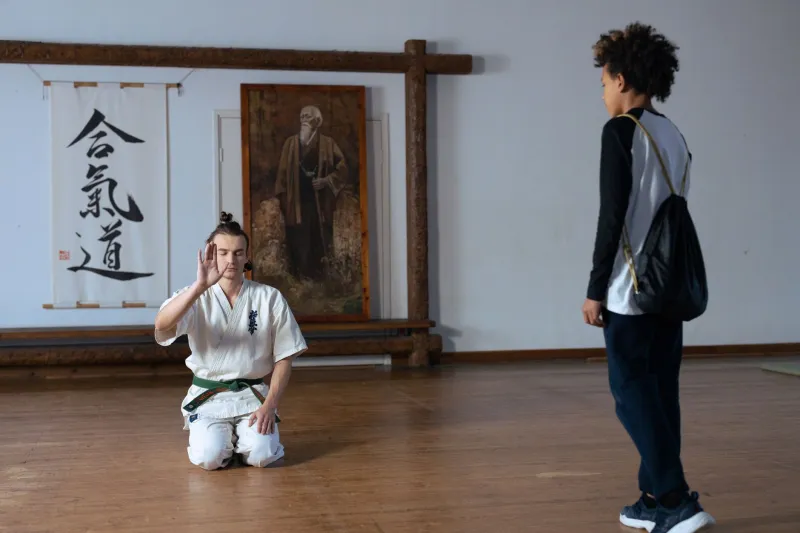
In a sunlit living room in suburban Colorado, twelve-year-old Marcus begins his school day not with a textbook, but with five minutes of seated stillness. His mother, a former public school teacher named Renata, calls it the "settling practice" — a simplified form of mindful breathing drawn from Japanese warrior tradition. Only after the silence does the formal curriculum begin. Marcus has been homeschooled for three years. He can recite the seven virtues of Bushido as readily as he can name the capitals of the fifty states.
Across the United States, a growing number of homeschooling families are making similar choices. They are incorporating Bushido principles, kenjutsu history, and broader Japanese cultural studies into the core of their children's education — not as novelty, but as a deliberate philosophical spine running through the entire school day. What these parents are finding, often to their own surprise, is that a centuries-old warrior code translates with unusual clarity into the values they most want to cultivate in their children: self-discipline, moral accountability, perseverance, and a sense of purpose that extends beyond individual achievement.
Why Bushido Resonates in the Homeschool Context
Homeschooling in America has grown substantially in recent years. According to data from the U.S. Census Bureau, the share of school-age children being educated at home roughly doubled between 2019 and 2021, with millions of families now operating entirely outside the traditional school system. Many of these parents deliberately sought alternatives not just for academic reasons, but because they wanted greater control over the values their children absorbed.
That search for a coherent moral framework is precisely where Bushido enters the picture. The samurai code — encompassing rectitude, courage, benevolence, respect, honesty, honor, and loyalty — is not a religious doctrine, nor is it culturally exclusionary. It is, at its core, a practical ethics system built around the cultivation of character under pressure. For parents who want their children to understand why honesty matters, why effort has intrinsic value, and why one's conduct toward others reflects directly on one's own integrity, the warrior's code offers a vocabulary that is both ancient and immediately applicable.
"We tried several character education curricula," says Renata. "Some felt preachy. Others were too vague. When I started reading about Bushido seriously — not the pop culture version, but the actual philosophy — I realized it was asking the same questions I wanted my son to wrestle with. What does it mean to do the right thing when no one is watching? What do you owe to the people in your community? How do you face difficulty without losing your sense of self?"
Structuring the 'Dojo Day'
Families who have integrated Japanese warrior philosophy into their homeschool practice tend to describe a similar structural approach. Rather than treating Bushido as a separate subject, they thread it through the entire school day as a governing principle.
Many begin with a short morning ritual — a moment of stillness, a recitation of the day's chosen virtue, or a brief physical practice such as stretching or basic bokken movements. This opening ceremony mirrors the rei, or formal bow, that begins every traditional martial arts class. It signals to the child that the learning space is distinct from ordinary domestic life, that a standard of conduct is expected within it.
Core academic subjects — mathematics, writing, history, science — are then taught through a lens of warrior values where possible. A lesson in fractions might be framed around the discipline of precise measurement in traditional Japanese sword-making. A writing assignment might ask a student to compose a letter in the voice of a ronin reflecting on a moment of moral failure. A history unit might trace the evolution of the samurai class from the Heian period through the Meiji Restoration, connecting those events to broader questions about duty, change, and identity.
Afternoons, in many of these households, are reserved for what families variously call "dojo time" — a structured period of physical training, whether that means attending a local kenjutsu or iaido class, practicing kata in the backyard, or working through a curated series of online instructional videos. The physical dimension is considered non-negotiable by most of these parents, who understand that Bushido was never intended to be purely intellectual. The body and the mind are trained together.
Sourcing Materials and Building a Curriculum
One of the practical challenges homeschooling parents face when building a Bushido-informed curriculum is the relative scarcity of age-appropriate, academically rigorous materials. Most resources on samurai philosophy are written for adult readers, and much of what is available for younger audiences tends toward the superficial or the purely martial.
Parents in this community have developed creative solutions. Many begin with foundational texts — Yamamoto Tsunetomo's Hagakure and Miyamoto Musashi's The Book of Five Rings are frequently cited as reference points for parents, even when the children themselves are working from simplified summaries or guided discussion questions drawn from those works. Inazo Nitobe's Bushido: The Soul of Japan, written in English and intended for a Western audience, is considered particularly accessible.
Beyond primary texts, families are drawing on resources in Japanese language instruction, traditional arts such as calligraphy and ikebana, Japanese history and geography, and the broader context of East Asian philosophy including Zen Buddhism and Confucian ethics. Platforms like HanzoEdu have become valued resources for families seeking structured, culturally grounded content that bridges ancient tradition and contemporary application.
Local dojo communities have also proven to be important partners. Several families described connecting with instructors who were willing to offer not just physical training, but contextual education — explaining the meaning behind each technique, the historical circumstances that shaped a particular kata, the philosophical principle a given movement was designed to embody.
What the Children Are Learning
Perhaps the most compelling evidence for this approach comes from the children themselves. Parents consistently report that Bushido's framework gives their kids a language for discussing ethical complexity that they might otherwise lack.
When Marcus was asked recently how he handled a conflict with a neighborhood friend, he described thinking about the principle of gi — rectitude, or moral rightness — before responding. "I wanted to say something mean back," he admitted. "But then I thought about whether that was the right action or just the easy one. They're not the same thing."
That kind of moral reasoning — calm, deliberate, grounded in a framework the child has genuinely internalized — is precisely what these families are working toward. Not obedience. Not rule-following. But the development of a self-directed ethical sensibility that will serve a young person long after formal schooling ends.
A Philosophy Built for the Long Road
The samurai did not train for a single battle. They trained for a lifetime of readiness — readiness to act with integrity, to endure hardship without complaint, to serve something larger than personal comfort. These are not values that belong exclusively to feudal Japan. They are, as a growing number of American families are demonstrating, values that translate with remarkable fidelity into the work of raising a child who is capable, principled, and genuinely prepared for the complexity of adult life.
The scroll has gone digital. The dojo has moved into the living room. And for thousands of families across this country, the warrior's path is becoming, one lesson at a time, the foundation of a genuinely rigorous education.