Empty the Cup, Quiet the Feed: How Zazen Is Giving Overstimulated American Teens a Way Back to Their Own Minds

A Classroom That Cannot Be Scrolled
On a Tuesday morning in a suburb outside Columbus, Ohio, sixteen-year-old Marcus Delaney sits cross-legged on a thin cushion in his family's spare bedroom. His phone is in another room. His eyes are lowered, not closed. His hands rest in his lap in a loose oval, the way his youth counselor showed him three months ago. He does not move for twenty-five minutes.
This is not a scene most people associate with American teenagers in 2025. It is, however, a scene that is quietly repeating itself in homes, school counseling offices, and community wellness centers from Portland, Oregon to suburban Atlanta. The practice is zazen — seated Zen meditation — and the teenagers discovering it are doing so not through a wellness app or a school assembly, but often through a counselor, a parent, or, increasingly, through an interest in Japanese martial arts and samurai philosophy.
For Marcus, the entry point was a documentary about kenjutsu. For others, it begins with a question their parents cannot answer: Why do I feel exhausted even when I haven't done anything?
The Samurai's Inner Discipline
To understand why zazen is relevant to teenagers today, it helps to understand why it mattered to the samurai in feudal Japan. Warriors of the Edo and Muromachi periods did not treat meditation as a supplemental wellness practice. They treated it as essential combat preparation. A mind cluttered with fear, distraction, or ego was, in their view, a liability on the battlefield. Zazen was the method by which a warrior cultivated mushin — literally, 'no mind' — a state of alert, unattached awareness in which the practitioner is fully present without being captured by any single thought or stimulus.
This was not passivity. Mushin was, paradoxically, the foundation of decisive action. A samurai who had trained the mind to release each arising thought without clinging to it could perceive a situation clearly and respond without hesitation. The stillness was not an end in itself. It was preparation for everything that followed.
The parallel to adolescent life in the digital era is not difficult to draw. American teenagers today are navigating a sensory environment that the human nervous system was not designed to process at this volume or velocity. The average American teen spends more than seven hours per day in front of screens outside of school, according to data from the American Psychological Association. Notifications, social comparisons, algorithmic content loops, and the low-grade anxiety of permanent digital availability have produced what many youth mental health professionals are now calling a generation in chronic cognitive overload.
Zazen does not fix this by removing the phone. It trains the mind to function differently in relation to stimulation — any stimulation.
What Families Are Actually Doing
Dr. Renee Holloway, a licensed clinical social worker who works with adolescents in the Denver metro area, began incorporating structured sitting practice into her sessions approximately two years ago after observing that conventional mindfulness exercises — guided meditations delivered via app — were producing minimal lasting results in her teen clients.
'The app-based approach has real value for some people,' she says, 'but for a lot of these kids, it was just another screen. Another thing happening to them rather than something they were actively practicing.' She began researching zazen specifically after a client's parent mentioned that their son had started sitting quietly each morning after becoming interested in samurai history. The change in the boy's classroom behavior, the parent reported, had been noticeable within six weeks.
Holloway now introduces a simplified zazen framework to willing clients: a designated cushion or folded blanket, a consistent time each morning, a duration that begins at five minutes and increases gradually, and a single instruction — notice each thought as it arises, and let it pass without following it. No app. No narration. No background music.
'What I tell them,' she says, 'is that the samurai didn't sit still because they were relaxed. They sat still because they were training. That framing matters to teenagers. It makes the discomfort feel purposeful.'
For parents, the practice often begins as an act of solidarity. Jennifer Castillo, a mother of two in the Houston area, started sitting alongside her fifteen-year-old daughter after the girl's therapist recommended structured meditation. 'I didn't know anything about zazen specifically,' Castillo admits. 'But I read about the samurai connection and something clicked for both of us. It wasn't about being calm. It was about being disciplined enough to choose where your attention goes.'
The Castillo household now maintains a shared ten-minute sitting practice on weekday mornings. Jennifer describes the change in her daughter's demeanor — particularly her ability to tolerate academic frustration without shutting down — as the most significant shift she has observed in years.
Beginning the Practice: What New Practitioners Need to Know
Zazen does not require a formal dojo, a teacher, or any specialized equipment to begin. What it does require is consistency and a willingness to sit with discomfort. The following framework is appropriate for teenagers and adults approaching the practice for the first time.
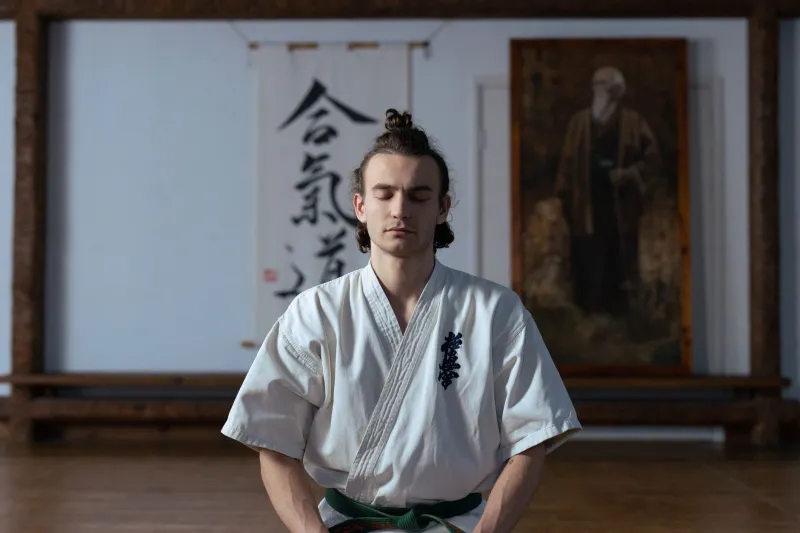
Posture before everything else. The body is not incidental in zazen — it is the starting point. Practitioners sit either in a cross-legged position on a cushion or in a kneeling position using a meditation bench. The spine should be upright without being rigid. The chin is slightly tucked. The hands form a loose oval in the lap, with the dominant hand cradling the other and the thumbs lightly touching.
Eyes open, gaze lowered. Unlike many Western meditation styles, traditional zazen is practiced with the eyes open and directed downward at approximately a forty-five-degree angle toward the floor. This keeps the practitioner anchored in the present environment rather than retreating inward.
Breath as the anchor. Attention is directed to the natural rhythm of the breath — particularly the exhalation. When a thought arises, the practitioner simply notices it and returns attention to the breath. The goal is not to prevent thoughts from arising. It is to avoid following them.
Begin with five minutes. Resistance to stillness is highest in the first weeks. A five-minute session practiced daily is more valuable than a thirty-minute session practiced occasionally. Duration should increase only when the shorter period feels genuinely sustainable.
Consistency over duration. The same time, the same location, the same cushion. Ritual consistency is not arbitrary in this tradition — it signals to the nervous system that this time and space are categorically different from the rest of the day.
The Most Relevant Ancient Tool in a Digital Age
There is a certain irony in the fact that one of the most effective responses to twenty-first century overstimulation may be a practice developed in medieval Japan. But the irony dissolves quickly when the underlying mechanism is examined. Zazen does not suppress the noise of modern life. It trains the practitioner to maintain a stable center of gravity — mental and attentional — regardless of what the surrounding environment is doing.
For a generation of American teenagers whose attention has been systematically fractured by design, that is not a small thing. It is, arguably, the foundational skill from which every other capacity for learning, relationship, and self-direction flows.
The samurai understood that the warrior who could not govern his own mind could not govern anything else. The teenagers sitting quietly in spare bedrooms and counseling offices across this country are, whether they know it or not, inheriting that understanding.
The cushion is waiting. The practice begins with a single breath.