The Warrior's Oath in Scrubs: How Samurai Philosophy Is Helping American Healthcare Workers Reclaim Their Purpose

The Warrior's Oath in Scrubs: How Samurai Philosophy Is Helping American Healthcare Workers Reclaim Their Purpose
The emergency department at a Level I trauma center does not pause. Shifts bleed into one another. Patients arrive in crisis. Decisions are made in seconds, and the emotional weight of those decisions accumulates over years in ways that no licensing exam ever prepares a clinician to carry. For many American healthcare workers, the profession they once entered with profound dedication has become a source of deep exhaustion — not physical fatigue alone, but a hollowing of spirit that the medical community now recognizes under a single, sobering term: burnout.
According to a 2023 survey published by the American Medical Association, more than half of physicians reported at least one symptom of burnout, a figure that rises sharply among emergency medicine specialists, ICU nurses, and paramedics. The traditional responses — employee assistance programs, mandatory wellness modules, mental health days — have offered limited relief. Something more foundational, it seems, is needed.
In an unlikely convergence, a growing number of frontline workers are finding that foundation not in a new clinical framework, but in the centuries-old philosophy of the Japanese warrior.
When the Code of the Samurai Meets the Code of Medicine
At its core, Bushido — the ethical and philosophical code by which samurai warriors conducted their lives — is a discipline of purposeful service under extreme conditions. It demands clarity of mind in chaos, acceptance of sacrifice, and an unwavering commitment to one's duty regardless of personal cost. To anyone who has worked a sixteen-hour overnight shift in an understaffed ICU, that description may sound startlingly familiar.
The parallel is not lost on Dr. Marcus Okafor, an emergency physician practicing in Houston, Texas, who began studying Bushido principles after a colleague introduced him to the concept of ikigai — a Japanese term roughly translated as "reason for being" or "the intersection of what you love, what you are good at, what the world needs, and what you can be recognized for." For Dr. Okafor, who had spent nearly two years questioning whether to leave medicine entirely, the framework offered something transformative.
"I had completely lost the thread," he recounts. "The work was still technically meaningful, but I couldn't feel it anymore. When I started studying ikigai seriously — not as a motivational poster concept, but as a genuine philosophical practice — I began to understand that I hadn't lost my purpose. I had lost my relationship to it."
He now incorporates brief ikigai reflection exercises into his pre-shift routine, a practice he describes as "recalibrating before stepping onto the floor."
Mushin and the Calm That Saves Lives
Beyond ikigai, another samurai concept is gaining traction in clinical circles: mushin, or "no-mind." In martial arts training, mushin refers to a state of mental clarity in which the practitioner acts without hesitation, fear, or the interference of overthought — a condition achieved through rigorous discipline and repetition. The samurai cultivated mushin precisely because their profession, like emergency medicine, demanded decisions made under mortal pressure.
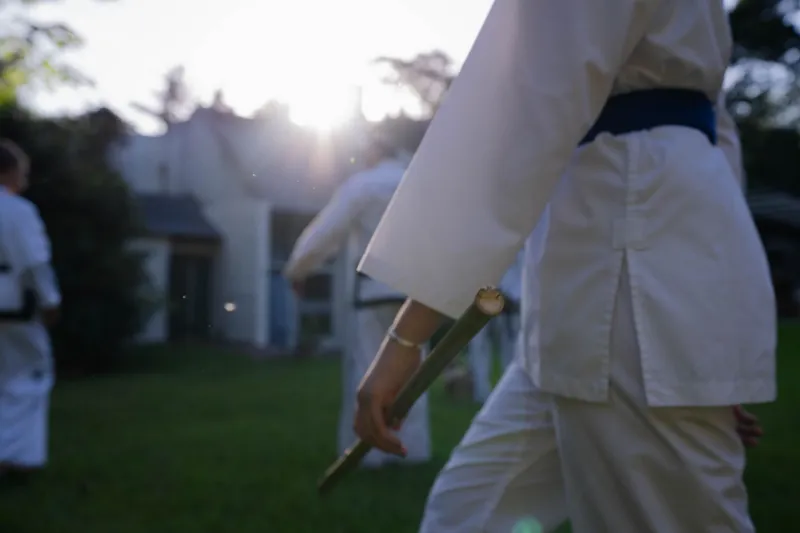
Critical care nurse Alicia Tran, who works at a major academic medical center in Chicago, began practicing kenjutsu — Japanese swordsmanship — three years ago at the recommendation of a fellow nurse who had trained in Japan. She was initially skeptical that swinging a wooden sword had any bearing on her nursing practice. The connection, however, revealed itself gradually.
"In kenjutsu, you train until your body knows what to do without your mind getting in the way," Tran explains. "In the ICU, when a patient codes, you don't have time to deliberate. Your training has to carry you. I started to realize I was training for mushin every time I walked into the dojo — and it was changing how I showed up at the bedside."
Tran has since introduced informal lunchtime discussions about samurai philosophy to her unit, drawing colleagues who describe the conversations as among the most practically useful wellness resources their hospital has offered.
Reframing Duty and Sacrifice
One of the more nuanced gifts Bushido offers healthcare workers is a philosophical language for the experience of sacrifice — something the profession demands constantly, yet rarely acknowledges with adequate depth.
In the samurai tradition, service to others was not viewed as self-diminishment but as the fullest expression of one's character. The warrior who endured hardship in service of a lord or community did not consider that endurance a loss; it was the very arena in which virtue was forged. This reframing carries genuine psychological weight for clinicians who have been conditioned to suppress their own needs in service of patient care.
Paramedic and martial arts instructor Devon Whitfield of Nashville, Tennessee, has spent the past four years running informal Bushido-based workshops for first responders through a local dojo. His curriculum does not romanticize the samurai tradition or minimize the very real systemic failures — staffing shortages, inadequate compensation, institutional indifference — that drive burnout. Instead, it offers participants a warrior's vocabulary for understanding their own experience.
"I'm not telling anyone that philosophy fixes a broken healthcare system," Whitfield says plainly. "What I am saying is that when you understand your work as a form of warrior service — when you connect it to something larger than a shift schedule — you carry it differently. The weight doesn't disappear, but you stop being crushed by it."
From Individual Practice to Institutional Consideration
While most Bushido-informed wellness efforts currently operate at the grassroots level — through individual practitioners, informal peer groups, and community dojos — there are early indications that healthcare institutions are beginning to take notice.
Several residency programs have quietly incorporated philosophical resilience modules that draw on Eastern traditions, and a handful of hospital wellness coordinators have begun attending workshops on ikigai facilitation. The integration remains nascent, and significant questions remain about how to introduce non-Western philosophical frameworks respectfully and effectively within diverse clinical environments.
The practitioners at the forefront of this movement are careful to position Bushido not as a cure-all, but as one dimension of a broader response to a systemic crisis. They are equally clear that the philosophy must be engaged with seriously — studied, practiced, and embodied — rather than reduced to motivational slogans on a break room wall.
The Dojo as Recovery Room
For Dr. Okafor, Alicia Tran, and Devon Whitfield, the dojo has become something the hospital system has rarely managed to provide: a space where the full complexity of their vocation — its demands, its costs, and its profound meaning — can be honestly confronted and metabolized.
The samurai, after all, were not simply fighters. They were practitioners of an integrated philosophy that encompassed discipline, compassion, aesthetic refinement, and the cultivation of an examined life. That the clinicians and first responders of twenty-first-century America are finding resonance in that tradition speaks to something enduring in the warrior's path — and something urgent in the American healthcare worker's search for it.
At HanzoEdu, we believe the way of Hanzo is not confined to the training floor. It lives wherever duty is taken seriously, wherever sacrifice is honored, and wherever a practitioner commits to showing up — fully, purposefully, and with an unbroken spirit — regardless of what the next moment may bring.
For those on the frontlines of American healthcare, that commitment sounds less like ancient philosophy and more like a daily reality. The samurai, it turns out, would understand completely.