Beyond the Belt: Why American Families Are Turning to Martial Arts Instructors as Guides for Life
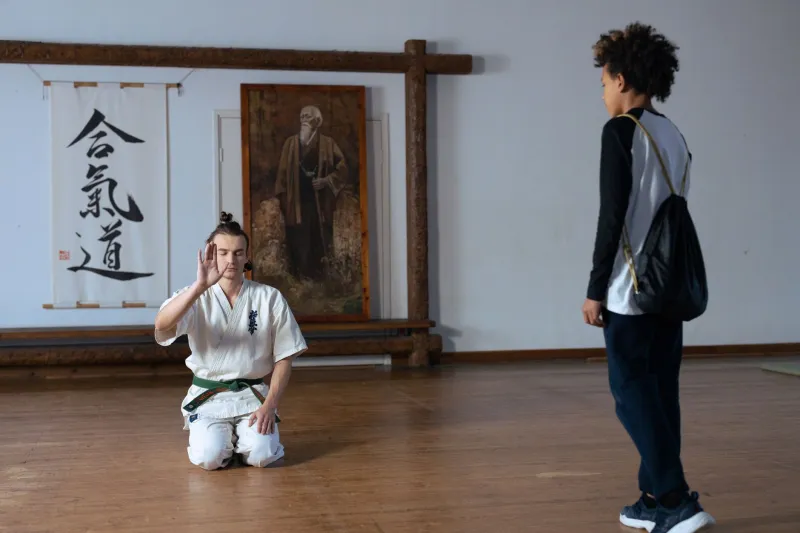
For most of the twentieth century, the American family's answer to a struggling child was a familiar sequence: school counselor, pediatric therapist, perhaps a life coach if the budget allowed. Today, a growing number of parents are finding a different answer — one that arrives in the form of a white-walled dojo, a disciplined instructor, and a philosophy rooted in the samurai tradition of mentorship known as senpai-kohai, the bond between a seasoned guide and an earnest student.
The trend is visible from suburban Phoenix to small cities in the Carolinas. Families are not simply enrolling their children in martial arts classes for self-defense or fitness. They are seeking out instructors who function as what might be called holistic sensei — teachers who address not only the mechanics of a punch or a throw, but the mechanics of a young person's character, decision-making, and inner resilience.
What the Dojo Offers That the Clinic Often Cannot
Dr. Miriam Castillo, a developmental psychologist based in Austin, Texas, has observed this shift among families in her practice. "What I hear from parents consistently," she notes, "is that their children respond to the dojo environment in ways they simply do not respond to a therapy room. There is something about the physical engagement, the clear hierarchy, and the earned progression that bypasses the resistance many adolescents carry into traditional counseling."
The samurai tradition has always understood this. The relationship between a sensei and a student was never purely technical. Historical accounts of feudal Japanese training halls describe instructors who observed their students' temperament, challenged their assumptions, and shaped their moral reasoning alongside their martial skill. The dojo was, in the oldest sense, a school of the whole person.
This is precisely what parents like David Harrington of Columbus, Ohio, were searching for when his thirteen-year-old son began struggling in middle school. "He was shutting down at home, disconnecting from us, getting into small but worrying conflicts at school," Harrington recalls. "We tried a therapist. He sat in silence for six sessions. Then a neighbor mentioned their son's instructor, and within eight weeks, I was watching my kid have genuine conversations about responsibility and respect — with this sensei — that he wouldn't have with anyone else."
The Mechanics of Trust in the Martial Arts Context
What makes the sensei relationship function as a mentorship vehicle is, in large part, structural. In a traditional dojo operating within the Bushido framework that HanzoEdu draws upon, authority is not arbitrary — it is earned visibly, through demonstrated skill, discipline, and integrity. Young students can see exactly why their instructor commands respect. That transparency builds trust in a way that institutional authority rarely achieves with adolescents.
Instructor Kenji Watanabe, who has operated a kenjutsu and life-skills program in Portland, Oregon, for eleven years, describes his approach deliberately. "I never separate the sword from the soul," he explains. "When a student struggles to hold the correct stance under pressure, we talk about what it means to maintain your principles when life is uncomfortable. The physical and the philosophical are the same lesson."
Watanabe reports that roughly forty percent of his current students were referred to him by parents who described their children as resistant to conventional support structures. Several had been asked to leave youth sports programs. A few carried diagnoses that had led to repeated conflicts in school settings. "What they needed," he says, "was not to be managed. They needed to be challenged within a framework that honored their potential."
Why Bushido's Honor Framework Resonates with Young Americans
The seven virtues of Bushido — righteousness, courage, benevolence, respect, honesty, honor, and loyalty — are not abstract ideals in the dojo context. They are operational standards applied to daily behavior and measured against real situations. A student who disrespects a training partner faces an immediate, structured consequence within a community that the student has chosen to belong to. That sense of chosen accountability is, for many young people, profoundly motivating.
Child development research consistently shows that adolescents respond better to accountability structures they perceive as fair, consistent, and attached to a community they value. The dojo, at its best, delivers all three. And unlike a therapy session that ends at the fifty-minute mark, the sensei relationship extends into the fabric of a student's week — through practice, through preparation, through the quiet discipline of showing up.
Parent Jennifer Okafor of Nashville describes the transformation in her fifteen-year-old daughter in terms that are both practical and deeply personal. "She used to make decisions based entirely on peer pressure. Now she pauses. She actually asks herself what the right thing to do is. Her sensei taught her that a warrior's greatest battle is the one fought inside. She quotes that to me. My teenager quotes samurai philosophy to me."
A Model Worth Examining
This does not suggest that martial arts instruction is a replacement for clinical mental health care. Instructors themselves are careful to draw that boundary. What it does suggest is that the sensei model — rooted in embodied learning, visible accountability, and a philosophy of earned growth — offers something distinct and valuable that families across the United States are actively seeking.
At HanzoEdu, we have long held that the Way of Hanzo is not confined to the training hall. It is a framework for living, one that is as relevant to a thirteen-year-old navigating middle school as it is to an executive navigating a boardroom. The growing presence of martial arts instructors as life mentors in American family life is not a trend so much as a recognition — that the oldest models of human development often carry the deepest wisdom.
The dojo is open. The question, for families who are ready, is whether they are willing to walk through the door.