Words from the Warrior: What the Private Writings of Samurai Reveal About Emotional Depth for American Men
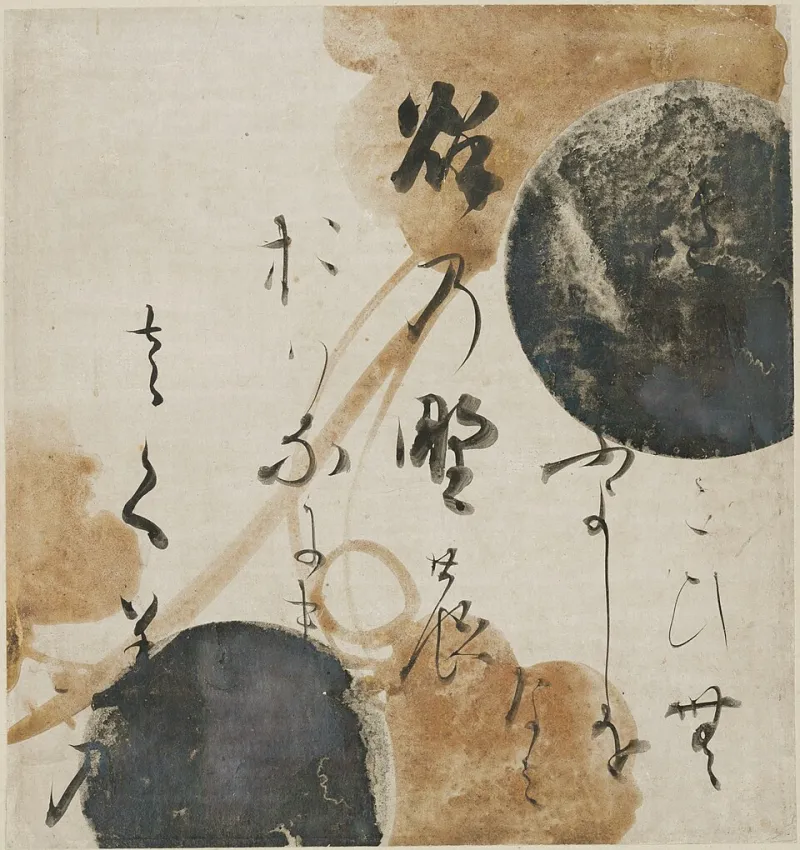
Photo: Honami Kōetsu, Public domain, via Wikimedia Commons
In the spring of 1600, a samurai commander named Naoe Kanetsugu composed a letter to a rival general that opened with a single, arresting line: "I have heard that you have been speaking ill of me. I take this as an honor." What followed was not a declaration of war but a sustained meditation on dignity, self-knowledge, and the nature of true courage—written with a literary precision that would not embarrass a professional poet.
Kanetsugu was not an anomaly. The historical record of feudal Japan is populated by warriors who expressed their inner lives with a sophistication that challenges nearly every assumption American culture holds about the relationship between masculinity and emotional articulation.
In an era when American men are facing a widely documented crisis of loneliness, disconnection, and psychological distress—and when the cultural conversation about male emotional expression often oscillates between dismissive and prescriptive—the private writings of the samurai offer something genuinely rare: a historical model of men who were simultaneously fierce and feeling, disciplined and tender, mortal and profoundly self-aware.
The Myth of the Silent Warrior
The popular image of the samurai in American culture—shaped largely by cinema and graphic novels—tends to emphasize silence, stoicism, and an almost robotic suppression of sentiment. This image is not entirely without basis. Restraint was indeed a cultivated virtue within Bushido. But restraint is not the same as absence, and the historical record makes clear that the inner lives of actual samurai were anything but emotionally barren.
The literary tradition known as jisei—the death poem, composed by samurai and Zen practitioners in the hours or moments before death—is among the most concentrated repositories of emotional honesty in world literature. These poems, written with the full knowledge that no tomorrow would arrive to judge or contextualize them, strip away every social convention and arrive at something irreducibly true.
Consider the final poem of Ōta Dōkan, the fifteenth-century warrior-poet who reportedly composed his death verse as he was being cut down:
"Had I not known / that I was dead already / I would have mourned / my loss of life."
This is not the writing of a man who lacked access to his interior world. It is the writing of a man who had cultivated that access with the same rigor he brought to swordsmanship—and who, in his final moment, deployed it with absolute precision.
Love, Loss, and the Warrior's Pen
Beyond the death poem tradition, samurai correspondence reveals an emotional register that will surprise readers conditioned to expect martial austerity. Letters between samurai and their families, preserved in historical archives across Japan, demonstrate men who wrote about love, grief, longing, and fear with an openness that contrasts sharply with contemporary American norms of male communication.
Toyotomi Hideyoshi, the great unifier of Japan, wrote letters to his wife Nene that are tender to the point of being disarming. In one famous exchange, he addresses her concerns about his fidelity with a combination of humor, contrition, and genuine affection that reads, across five centuries, as remarkably human. This was a man who commanded armies and reshaped a nation—and who was also, in his private correspondence, emotionally present in ways that many modern American men struggle to achieve in their most intimate relationships.
The philosophical writings of Yamamoto Tsunetomo, compiled in the Hagakure, are similarly complex. While the text is often cited for its austere declarations about the nature of the warrior's path, it is equally replete with observations about friendship, devotion, and the importance of being genuinely known by another person. Tsunetomo writes about the bonds between samurai with a warmth that reads not as weakness but as the natural expression of a man fully inhabiting his humanity.
What American Male Socialization Gets Wrong
The contrast with contemporary American male socialization is instructive. Research by sociologists such as Niobe Way at New York University has documented a troubling pattern: American boys enter adolescence with rich emotional vocabularies and deep friendships, and systematically lose both as they are socialized into conventional masculine norms that equate emotional expression with vulnerability, and vulnerability with weakness.
The consequences are measurable. American men report significantly fewer close friendships than women, are substantially less likely to seek mental health support, and die by suicide at nearly four times the rate of American women. The emotional isolation that these statistics represent is not a product of male nature. It is a product of a cultural script that has stripped men of the very tools they need to sustain meaningful connection.
The samurai tradition does not solve this problem by asking men to become something other than warriors. It solves it by insisting that the fullest expression of the warrior includes emotional depth. Bunbu ryōdō—the dual path of literary and martial cultivation—was a foundational ideal of samurai culture. A man who could not write a poem, compose a letter with genuine feeling, or engage in philosophical reflection was considered incomplete, regardless of his skill with a blade.
Reading the Warrior's Words as a Practice
At HanzoEdu, the engagement with classical samurai texts is understood not merely as historical study but as a living practice. Reading the death poems of Zen master warriors, tracing the emotional arc of a general's correspondence with his family, sitting with the philosophical reflections of men who faced mortality daily and chose to do so with open eyes—these are acts of encounter that can genuinely expand the emotional vocabulary of modern men.
This is not an invitation to romanticize feudal Japan or to ignore its profound injustices. It is an invitation to recognize that the binary between strength and feeling—the binary that American culture presents as natural and inevitable—is, in fact, a cultural construction. And like all constructions, it can be examined, questioned, and revised.
The samurai did not express emotion despite their discipline. They expressed it because of it. The capacity to feel deeply, to articulate that feeling with precision, and to remain grounded in the midst of it—this was understood as a form of mastery no less demanding than the mastery of the sword.
The Letter You Have Not Written
There is a practice, simple but demanding, that emerges naturally from engagement with the samurai literary tradition. It is this: write the letter you have not written. Not the email drafted in a moment of frustration, not the text composed under the pressure of immediacy—but the considered, honest expression of what you actually feel toward someone who matters to you.
The samurai who composed his death poem did not have the luxury of revision or delay. He wrote what was true because time had run out for anything less. Most American men, mercifully, have time remaining. The question the samurai tradition poses—quietly, insistently—is whether they will use it.