Steel Forged in Fire: How the Warrior's Code Is Rewriting the Stories of Americans Emerging from Incarceration
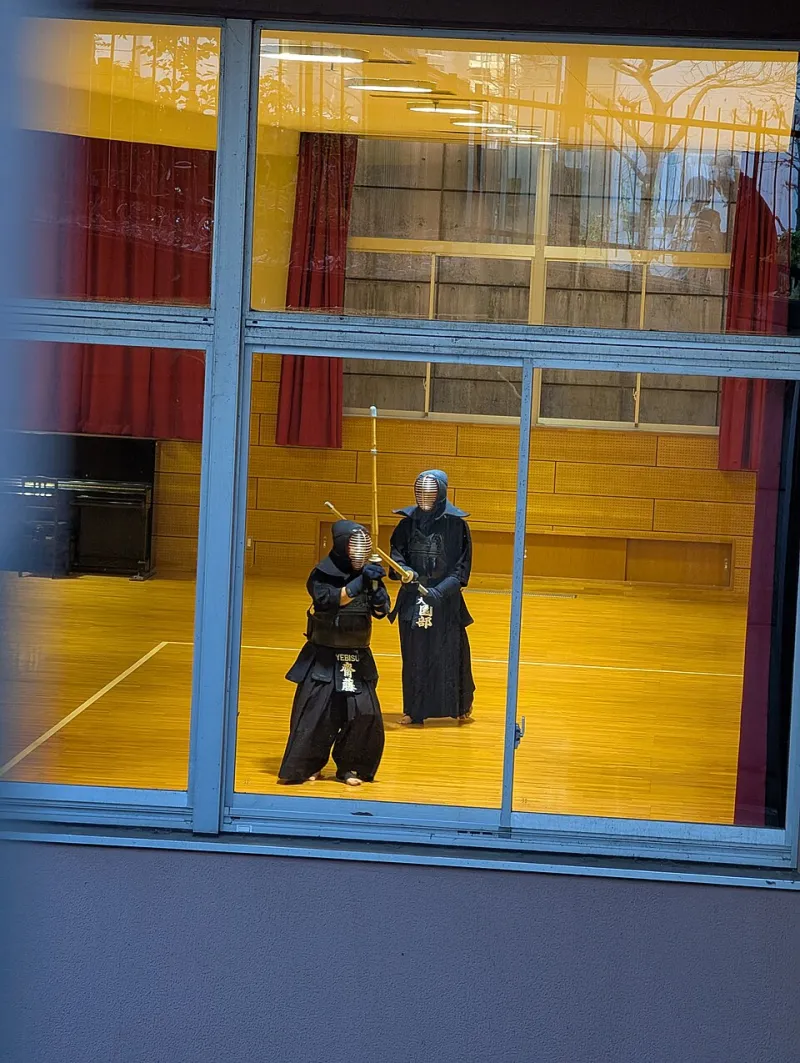
Photo: Syced, CC0, via Wikimedia Commons
For many Americans leaving correctional facilities, the most daunting challenge is not legal or logistical — it is the question of who they are allowed to become. In dojos and community centers across the country, kendo and samurai philosophy are offering a radical answer: the warrior's code does not recognize a person's worst chapter as their final one. These are the stories of men and women who found, in the discipline of the sword, the architecture of a new self.
The Weight That Follows You Out
The statistics surrounding reentry in the United States are well documented and sobering. According to the Bureau of Justice Statistics, approximately two-thirds of released prisoners are rearrested within three years of release. The barriers are formidable and well known — housing instability, employment discrimination, fractured family relationships, and the psychological aftermath of incarceration itself.
But beneath these structural challenges lies something less frequently discussed: the crisis of identity that accompanies release. A person who has spent years defined by a number, a cell block, and a criminal record often emerges without a coherent answer to the most fundamental of human questions — who am I now, and what kind of person am I capable of being?
It is in this interior landscape that the samurai tradition has found, perhaps unexpectedly, some of its most receptive students.
The Philosophy of the Unfinished Self
Central to Bushido — the ethical code that guided the samurai class — is a concept that Western self-help culture has struggled to articulate with comparable precision: the idea that the self is not a fixed destination but a continuous practice. The Japanese term kaizen, meaning continuous improvement, captures part of this orientation, but the warrior tradition goes further. It holds that a person's character is not revealed in their moments of ease but forged in their moments of reckoning.
The samurai did not romanticize failure. He studied it. Hansei, the practice of honest self-reflection, demanded that the warrior examine his shortcomings without denial and without theatrical self-flagellation — and then return to training. The past was acknowledged, not as a permanent verdict, but as a teacher.
For individuals carrying the stigma of incarceration, this framework represents something genuinely rare in American culture: a philosophy that takes personal responsibility with absolute seriousness while simultaneously refusing to treat any single chapter of a life as the whole story.
"In the dojo, nobody cares what you were," says Darnell Washington, who spent seven years in a federal correctional facility in the Midwest and discovered kendo through a reentry program two years after his release. "They care what you do with the next two hours. That was the first time since I was a teenager that I felt like I was being evaluated on something I could actually control."
Kendo as Ceremony and Structure
Kendo — the Japanese martial art of sword fighting, practiced with bamboo shinai and protective armor — is, on the surface, a physically demanding sport. But for practitioners immersed in its deeper tradition, it is something closer to a moving meditation on character.
The rituals of kendo are deliberate and layered with meaning. The bow at the entrance to the dojo is not a formality. It is a declaration that one is crossing a threshold — leaving the ordinary world behind and entering a space governed by different rules. The careful donning of armor, the precise arrangement of equipment, the formal opening and closing of practice — each element serves to remind the practitioner that they are engaged in something that demands their full self.
For individuals whose previous environments offered chaos, unpredictability, and the constant management of threat, the structured ceremonialism of kendo can be profoundly stabilizing. Dr. Yolanda Reyes, a clinical social worker in Chicago who has facilitated martial arts programming in partnership with a local reentry nonprofit for the past five years, describes the effect with care.
"What I observe is that the structure of the dojo creates a kind of psychological safety that many of my clients have never experienced in a community setting," she explains. "There are clear expectations. There is a hierarchy that is earned rather than imposed. There is immediate feedback — the shinai does not lie. And there is the experience of being corrected without being humiliated, which for many people is genuinely novel."
Personal Responsibility Without Permanent Judgment
One of the most distinctive features of the samurai ethical tradition, as it applies to this population, is its particular understanding of accountability. Bushido demands absolute personal responsibility — the warrior does not deflect, minimize, or excuse. He owns his actions with complete transparency.
But that same tradition draws a sharp distinction between accountability and shame. Shame, in the Bushido framework, is a condition that paralyzes. It turns the gaze permanently inward and backward, consuming the energy that should be directed toward improvement. The warrior acknowledges what occurred, makes whatever reparation is possible, and then — critically — he returns to the path.
This distinction resonates powerfully with practitioners who have spent years navigating a justice system that, whatever its rehabilitative aspirations, often communicates to individuals that their offense is their identity.
Maria Elena Castillo, who served four years in a state correctional facility in Texas and has been practicing a Bushido-based personal development curriculum for the past eighteen months since her release, describes the shift in terms that are both precise and moving.
"I used to wake up every morning and the first thing I thought was, 'I am a convicted felon.' That was the sentence I gave myself every single day," she says. "The philosophy I've been studying says something different. It says you are what you practice. So I started asking myself: what am I practicing today? That question changed everything."
Building Programs That Honor the Tradition
Across the United States, a growing number of organizations are working to bring martial arts and samurai philosophy into correctional and reentry contexts. These programs vary in their structure, but the most effective share several characteristics that align with the deeper principles of Bushido practice.
They emphasize process over outcome, teaching participants to find meaning in the daily commitment to training rather than in the pursuit of rank or recognition. They incorporate hansei — structured self-reflection — as a regular component of practice, giving participants a disciplined framework for examining their choices without descending into unproductive self-criticism. And they situate individual growth within a community of practitioners, recreating the sense of belonging that the samurai found in his ryu, or school of training.
Dr. Reyes notes that the community dimension is frequently the element participants identify as most transformative. "Many of my clients describe incarceration as profoundly isolating, even when surrounded by other people," she says. "The dojo offers genuine belonging — a community where your progress is celebrated and your struggles are held with respect. That is not a small thing. For many people, it is everything."
The Sword as Mirror
There is a phrase used in traditional kendo instruction that translates, approximately, as "the sword reveals the mind." The meaning is straightforward: the quality of your technique reflects the quality of your inner state. Tension, fear, aggression, distraction — all of it appears in the way the shinai moves. The practice cannot be faked.
For Americans rebuilding their lives after incarceration, this unsparing honesty is not a punishment. It is a gift. In a world that frequently reduces them to their records, the dojo offers something more demanding and more generous: the invitation to be seen, fully and honestly, in this moment — and the assurance that what is seen in this moment can be shaped by what they choose to do next.
The samurai tradition has always held that steel is made stronger by the fire that tests it, not weaker. For the men and women who are choosing the warrior's path after the hardest chapters of their lives, that understanding is not merely philosophy.
It is the beginning of a new practice.