One Warrior, Two Worlds: The Samurai Art of Dual Mastery and What It Teaches American Parents About Screens and Presence
Parenting in the digital age can feel like standing in the center of a battlefield with a weapon in each hand and no training for either. On one side, a smartphone — glowing, insistent, algorithmically designed to command attention. On the other, the warm, irreplaceable texture of real-world family life: dinner conversations, weekend hikes, eye contact across a kitchen table. Most American parents sense they must manage both, yet few feel equipped to do so without guilt, conflict, or the creeping suspicion that they are failing at one or the other.
The samurai tradition offers a surprisingly coherent answer to this modern dilemma — not through rigid prohibition, but through the philosophy of nito-ryu, the art of dual-sword fighting.
The Philosophy of Two Swords
Miyamoto Musashi, the seventeenth-century swordsman and philosopher whose Book of Five Rings remains widely studied today, developed a style of combat in which both hands wielded blades simultaneously. His insight was not simply technical. Musashi understood that mastery of two instruments demanded a practitioner develop a unified center — a calm, deliberate core from which all movement originated. Without that center, two swords became two liabilities.
For parents, the parallel is immediate. The smartphone and the living room are not opposites to be defeated. They are two instruments that, without a governing philosophy, will pull a household in opposing directions. With one, they become tools of a coherent family culture.
At HanzoEdu, this principle sits at the heart of how we approach modern parenting education. The question is never simply how much screen time but rather from what center are you making that decision?
The Dojo's First Lesson: Discipline Is Not Punishment
American culture has a complicated relationship with the word discipline. It tends to conjure images of restriction, punishment, or rigid schedules that leave no room for spontaneity. In the dojo, discipline means something entirely different. It is the cultivation of reliable habits that serve a practitioner's deepest intentions.
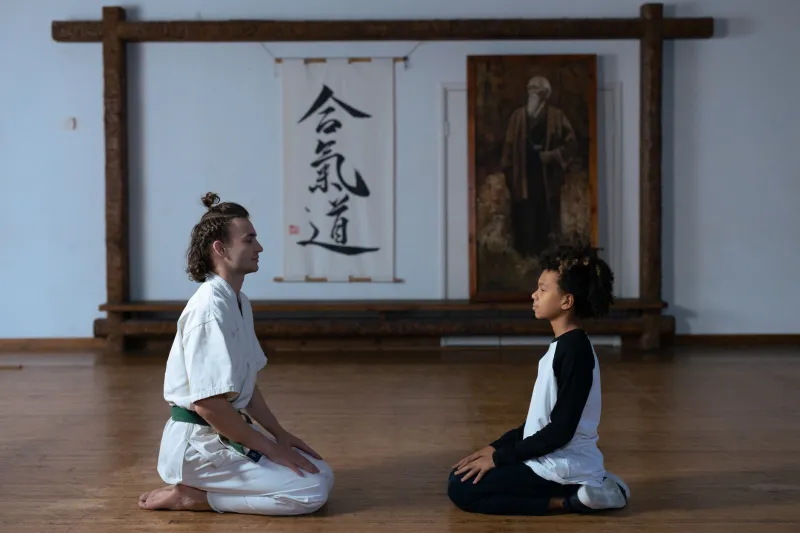
When a martial arts student bows upon entering the training space, they are not performing obedience. They are signaling a transition — from the noise of the outer world to the focused attention of practice. This ritual boundary is one of the most transferable concepts in samurai philosophy, and it is profoundly applicable to family life.
Consider the dinner table. Rather than engaging in a pitched battle over phones at meals — a conflict that breeds resentment on all sides — families trained in dojo thinking create a ritual threshold. Phones are placed in a designated location before the meal begins, not as punishment, but as a ceremony of presence. The act of setting the phone down becomes as meaningful as the bow at the dojo door. It signals: this time, this space, belongs to something else.
Research from the American Psychological Association consistently supports what samurai philosophy intuitively understood: structured transitions reduce behavioral conflict and increase cooperative engagement among children. The dojo simply gave that structure a name and a dignity.
Presence as a Warrior Skill
Samurai philosophy places extraordinary value on zanshin — a state of relaxed, sustained awareness that persists even after an action is completed. A warrior who strikes and then mentally departs the moment has left themselves vulnerable. Zanshin demands that attention remain alive, responsive, and rooted in the present.
For parents, zanshin reframes the concept of presence. Being physically in the room while mentally scrolling a news feed is not presence — it is the parenting equivalent of a warrior who has already left the battlefield. Conversely, allowing a child to use a tablet while a parent remains genuinely attentive and available is not negligence. It is zanshin applied to the complexity of modern family life.
This distinction matters enormously because it relieves parents of an impossible standard — the idea that screens must be absent for presence to exist — while simultaneously raising the bar on what genuine attention actually requires. The samurai did not demand the elimination of complexity. They demanded mastery of one's response to it.
Boundaries That Strengthen Rather Than Sever
One of the more counterintuitive teachings from the dojo is that boundaries, when properly constructed, do not weaken relationships — they fortify them. In martial arts training, the rules of engagement between sparring partners are not restrictions on the relationship. They are the very architecture that makes trust, growth, and genuine connection possible.
Parents who adopt this framework stop viewing screen-time limits as adversarial policies and begin designing them as shared agreements — the family's equivalent of dojo rules. These agreements work best when children are involved in their creation, when they apply equally to adults in the household, and when they are explained not as arbitrary restrictions but as expressions of what the family values.
A parent who puts their own phone away during homework hour is not simply enforcing a rule. They are modeling bushido — the warrior's code — in its most accessible domestic form. They are demonstrating that disciplined attention is a practice, not a punishment, and that it applies to everyone willing to train.
Training, Not Perfection
Perhaps the most liberating aspect of samurai philosophy for overwhelmed American parents is its relationship to imperfection. The dojo is not a place where masters perform. It is a place where practitioners train. Failure, inconsistency, and the need to begin again are not signs of inadequacy. They are the very substance of growth.
There will be evenings when the agreed-upon boundaries collapse entirely. There will be weeks when everyone in the household is glued to a screen longer than intended, when the ritual threshold gets skipped, when zanshin gives way to distraction. The samurai tradition does not ask for a perfect record. It asks for a return to practice.
For American parents conditioned to measure success in outcomes rather than effort, this reorientation is itself a form of liberation. The goal is not to raise children who never struggle with digital distraction. The goal is to build a family culture in which the practice of intentional attention is ongoing, honored, and — crucially — modeled by the adults in the room.
The Unified Center
Musashi's two swords were never the point. The point was the unified center from which both were wielded. For families navigating the digital and real-world dimensions of modern life, that center is a shared set of values: presence, intentionality, mutual respect, and the willingness to keep practicing even when the practice is imperfect.
The samurai did not fear complexity. They trained for it. American parents, equipped with the same philosophical framework, need not fear the smartphone or the algorithm. They need only find — and keep returning to — the still point from which both worlds can be held with purpose.