No Lord, No Limits: What the Samurai Ronin Teaches the Modern American Freelancer

The ronin — a samurai who served no master — was once regarded as a figure of dishonor in feudal Japan. Today, reexamined through the lens of a post-corporate American economy, the ronin's defining characteristics look less like failure and more like a blueprint for a kind of professional freedom that millions of Americans are actively choosing. The parallels are not merely poetic. They are instructive.
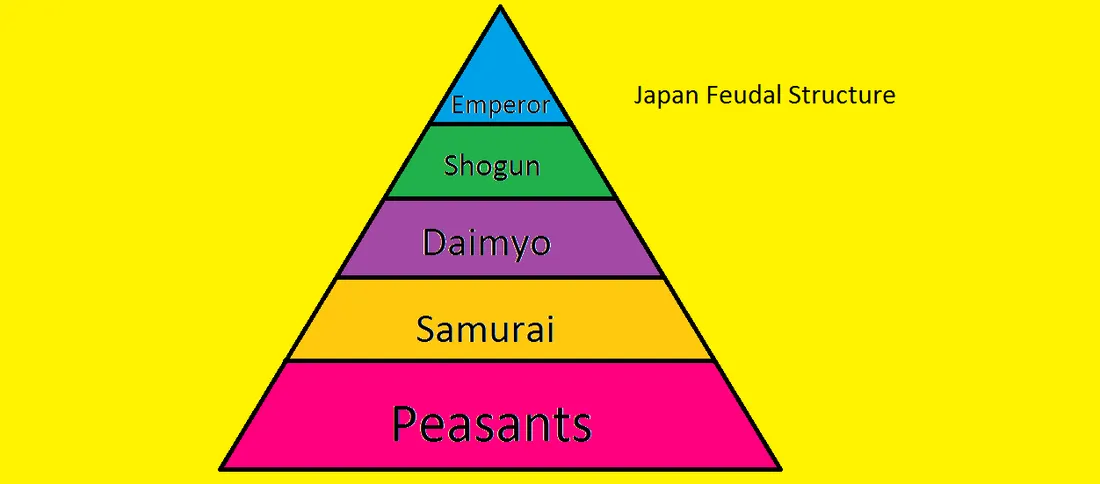 Photo: feudal Japan, via japanesefeudalstructure.weebly.com
The Historical Ronin: Outcast or Pioneer?
In feudal Japanese society, a samurai derived identity, income, and social standing from loyal service to a daimyo — a feudal lord. When that relationship ended, whether through the lord's death, defeat in battle, or the samurai's own dismissal, the warrior became ronin: literally, "wave person," one who drifts without anchor.
The term carried stigma. A ronin was presumed to have failed in some fundamental duty. Yet history records a more complicated truth. Many ronin became teachers, philosophers, strategists, and craftsmen. Miyamoto Musashi — perhaps the most celebrated swordsman in Japanese history — was a ronin who spent decades traveling, refining his art, challenging established masters, and ultimately writing The Book of Five Rings, a text still studied in business schools and military academies worldwide. He served no lord. He answered to his own standard.
 Photo: The Book of Five Rings, via i.pinimg.com
 Photo: Miyamoto Musashi, via wallpapers.com
The ronin, reexamined honestly, was not a broken warrior. He was a self-directed one.
The Numbers That Define a New American Workforce
According to a 2023 report from Upwork, approximately 59 million Americans performed freelance work in the prior year — representing nearly 38 percent of the total U.S. workforce. Projections suggest that independent workers could constitute the majority of the American labor market within the next decade. The McKinsey Global Institute has described this as one of the most consequential structural shifts in modern economic history.
These are not all people who could not find traditional employment. A substantial portion are people who chose to leave it. Surveys consistently show that among experienced freelancers — those who have operated independently for three or more years — the majority report higher job satisfaction than their salaried counterparts, despite accepting greater financial variability.
They left the castle. And many of them have not looked back.
The Ronin's Code, Translated for the Gig Economy
What made the historical ronin effective — and what distinguished the ones who flourished from the ones who simply drifted — was not the absence of a master. It was the presence of an internalized code that replaced external authority with personal discipline.
This is the insight that translates most directly to modern freelance life.
In the corporate structure, external systems provide the scaffolding of professional behavior: performance reviews, management hierarchies, institutional deadlines, and defined roles. Remove that scaffolding, and many professionals discover that they were never building the internal architecture to support themselves. The freelancer who struggles is frequently not struggling with market demand or skill deficiency. They are struggling with the absence of external structure they never learned to replace.
The ronin's answer to this problem was bushido — the warrior's ethical code — applied not as external law but as personal standard. Translated into contemporary professional terms, this means establishing your own criteria for quality, your own non-negotiable principles for client relationships, your own rhythms of work and recovery, and your own definition of what constitutes honorable conduct in the marketplace.
This is not abstract philosophy. It is operational necessity.
Self-Reliance Without Isolation
One of the most persistent misconceptions about independent work — and about the ronin — is that operating without a lord means operating alone. Historical ronin frequently formed alliances, took on students, collaborated with other masterless warriors, and embedded themselves in community structures that suited their skills. Musashi himself spent years in residence with various schools and patrons, never surrendering his independence but never pretending that isolation was the same as strength.
The modern parallel is the freelance professional who builds a deliberate network — not as a transactional contact list, but as a genuine community of peers who provide accountability, referrals, intellectual challenge, and mutual support. The solopreneur who joins a mastermind group. The independent consultant who maintains long-term relationships with former colleagues. The gig worker who invests in a professional community rather than treating every engagement as a discrete transaction.
The ronin understood that self-reliance and community are not opposites. Independence is a posture, not a wall.
Adaptability as a Martial Virtue
Miyamoto Musashi wrote extensively about the necessity of having "no fixed form" — of being able to respond to the conditions of any given engagement rather than relying on a single preferred strategy. He trained in multiple weapon styles. He studied painting, sculpture, and strategy. He refused to become a specialist in only one dimension of his art.
For the modern American freelancer or entrepreneur, this concept has immediate practical relevance. The professionals who sustain independent careers over the long term are rarely those who found one lucrative niche and defended it indefinitely. They are the ones who built transferable skills, remained genuinely curious about adjacent fields, and treated each new client engagement as an opportunity to learn something, not merely to deliver something.
The ronin's adaptability was not restlessness. It was a cultivated readiness — the professional equivalent of what Japanese martial tradition calls zanshin: sustained, alert awareness of the environment, never fully at rest, never caught entirely off guard.
The Question of Honor in a Transactional Economy
Perhaps the most challenging dimension of the ronin philosophy to apply in contemporary professional life is the concept of personal honor — meiyo — as a guiding principle that exists independent of whether anyone is watching.
In a gig economy defined by anonymous reviews, algorithmic matching, and short-term engagements, the temptation to optimize for the transaction rather than the relationship is structural, not merely personal. Platforms reward speed and volume. Clients often select on price. The conditions of modern independent work can quietly erode the standards that make independent work meaningful.
The ronin's answer — and it is the most demanding one — is that honor is not a reputation management strategy. It is a practice. The freelancer who delivers work of genuine quality on a project no one will notice, the consultant who tells a client an uncomfortable truth rather than a comfortable one, the solopreneur who declines an engagement that conflicts with their stated values — these are not naive gestures. They are the compounding investments of a professional who intends to sustain a career over decades, not quarters.
Choosing the Ronin Path Deliberately
The ronin of feudal Japan did not always choose his condition. Circumstance often chose it for him. The modern American professional, by contrast, increasingly has the opportunity to choose independence deliberately — to leave the corporate structure not because it expelled them but because they have decided to operate by their own code.
That choice demands something the employment contract never required: a clear, examined, personally authored set of principles that will govern conduct when no external authority is present to enforce it.
At HanzoEdu, we return often to the idea that the warrior's path is ultimately an inward one. The sword, the bow, the strategy — these are instruments of a deeper discipline. The ronin who flourished was not the one who found a new lord most quickly. It was the one who discovered, in the absence of a lord, what they were actually made of.
That discovery is available to anyone willing to make it. The only requirement is the courage to begin.