The Strength That Does Not Shout: How the Samurai Tradition Is Empowering Introverted Americans to Lead on Their Own Terms
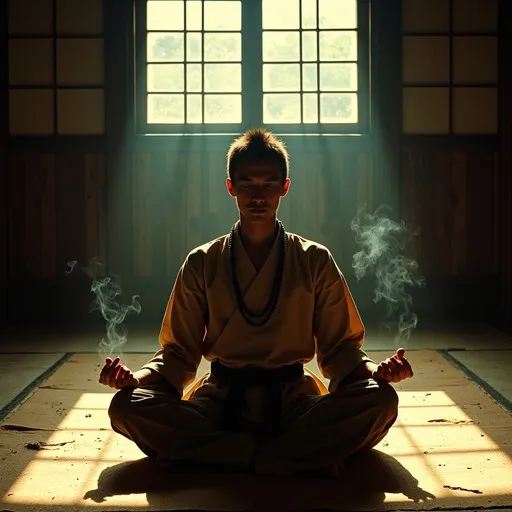
Photo: introverted person meditating alone in quiet dojo martial arts training space, via images.stockcake.com
American professional culture has a visibility problem. Across industries — from corporate boardrooms to university lecture halls to the open-plan offices that now dominate metropolitan workplaces — the qualities most reliably rewarded tend to cluster around a particular personality profile: outspoken, gregarious, quick to offer opinions, comfortable commanding a room. The introvert, in this environment, is frequently misread. Their silence is interpreted as passivity. Their deliberation is mistaken for hesitation. Their preference for depth over breadth is catalogued as a social deficit rather than a cognitive strength.
The samurai tradition, studied and practiced through HanzoEdu's curriculum, offers a direct and substantive challenge to this cultural assumption. Not as a polemic, but as a philosophical system that was built — from the ground up — around the virtues that introverts tend to embody most naturally.
The Warrior Who Listens First
In the classical samurai tradition, the most dangerous opponent was rarely the loudest one. The warrior who announced their intentions, who performed their confidence for an audience, who spoke before they had observed — this was a warrior who had already compromised their position. The most formidable practitioners were those who had developed the capacity to absorb their environment fully before committing to action.
This principle, known in Zen-influenced martial philosophy as kanken — the ability to see with both the eyes and the mind — was not a consolation prize for those who lacked aggression. It was considered a sophisticated and difficult skill, one that required years of deliberate cultivation. Observation was not the precursor to action. In many contexts, it was the action.
For introverted Americans who have spent careers being told to speak up more, be more assertive, or project greater confidence, this reframing is not merely encouraging — it is philosophically grounding. The dojo does not ask the introvert to become someone else. It asks them to go deeper into who they already are.
Stillness as a Competitive Advantage
The Japanese concept of fudoshin — the immovable mind — describes a state of inner composure that cannot be disrupted by external provocation. It is not blankness or detachment. It is a quality of settled attention that allows a practitioner to perceive clearly and respond precisely, even in conditions designed to produce panic or reactivity.
In the contemporary American workplace, the ability to remain composed under pressure — to resist the impulse to fill silence with noise, to think before speaking, to respond rather than react — is increasingly recognized as a leadership differentiator. Research from organizational psychologists at institutions including Harvard Business School has suggested that introverted leaders frequently outperform their extroverted counterparts in environments that require careful listening, nuanced decision-making, and the capacity to draw out the contributions of others.
The samurai tradition gave fudoshin a name and a training methodology long before organizational psychology existed as a discipline. The dojo, in this sense, was always a laboratory for the development of exactly the qualities that introverted practitioners bring most naturally to their work.
The Dojo as a Space Built for Deep Attention
Walk into a traditional dojo and you will encounter something increasingly rare in American life: a space designed specifically to reward depth of attention over speed of reaction. The rituals of the training environment — the bow, the silence before practice, the careful observation of technique before its execution — are not ceremonial flourishes. They are the pedagogical architecture of a system that understands learning as a slow, layered, internal process.
For introverted students and professionals who have spent years in educational and professional environments that reward the loudest answer rather than the most considered one, the dojo can feel, initially, like a revelation. The training does not ask them to perform confidence they do not yet possess. It asks them to practice, observe, and allow understanding to deepen through repetition and reflection.
This pedagogical approach has direct application beyond the training floor. Introverted professionals who have engaged with HanzoEdu's curriculum frequently describe a shift in how they approach high-stakes situations — presentations, negotiations, creative reviews — after internalizing the dojo's framework. They stop trying to manufacture extroversion and begin deploying the deliberate, prepared, observation-driven approach that the samurai tradition valorizes.
Purpose Over Performance
One of the more subtle but consequential teachings in bushido concerns the distinction between action taken for genuine purpose and action performed for an audience. The samurai code held in low regard the warrior whose conduct was shaped primarily by the desire for recognition. True budo — the martial way — demanded that a practitioner's commitment to their art be independent of external validation.
This principle speaks directly to one of the central tensions that introverted Americans navigate in a culture saturated with social media metrics, personal branding imperatives, and the relentless pressure to be visible. The introvert who has internalized the bushido framework is not indifferent to the world's response to their work. They are simply no longer governed by it. Their standard of excellence is internal, their motivation is intrinsic, and their development is measured in the quality of their practice rather than the volume of their audience.
In creative fields particularly — writing, visual art, music composition, software development — this orientation produces work of a depth and specificity that performance-driven approaches rarely achieve. The introvert who writes, designs, or codes in alignment with a deeply internalized standard, without constant reference to external approval, often produces work that is more original and more durable than that of peers who are perpetually calibrating their output to perceived audience expectations.
Speaking When It Matters
A common misreading of introversion — and of the samurai's characteristic economy of speech — is that it implies an unwillingness to engage. In practice, the opposite is true. The samurai who spoke rarely did so because they understood that words, like sword strokes, derive their power from precision and timing. A practitioner who speaks constantly diffuses the impact of their communication. One who speaks deliberately, when something genuinely worth saying has been formulated, commands attention in a way that volume alone cannot achieve.
Introverted Americans who have internalized this framework describe a meaningful shift in their professional and personal relationships. They stop apologizing for their silence and begin recognizing it as preparation. When they do speak — in meetings, in negotiations, in creative collaborations — they find that the quality of their contributions carries a weight that their more voluble colleagues struggle to replicate.
This is not a strategy. It is the natural outcome of a philosophical system that has always understood restraint as a form of power.
The Rebellion That Requires No Announcement
There is something quietly radical about an introvert who has stopped trying to perform extroversion — who has, instead, committed to the disciplined development of their actual capacities. In a culture that celebrates the loudest voice in the room, choosing to cultivate depth rather than volume is, in its own understated way, an act of defiance.
The samurai tradition does not ask its practitioners to announce this defiance. It asks them to embody it — in the quality of their attention, the precision of their action, and the steadiness of their presence under pressure. For introverted Americans who have spent years feeling that their natural tendencies were obstacles to be overcome, the dojo offers something more valuable than encouragement. It offers a philosophical tradition that has always known what they are capable of — and has the training methodology to help them prove it.